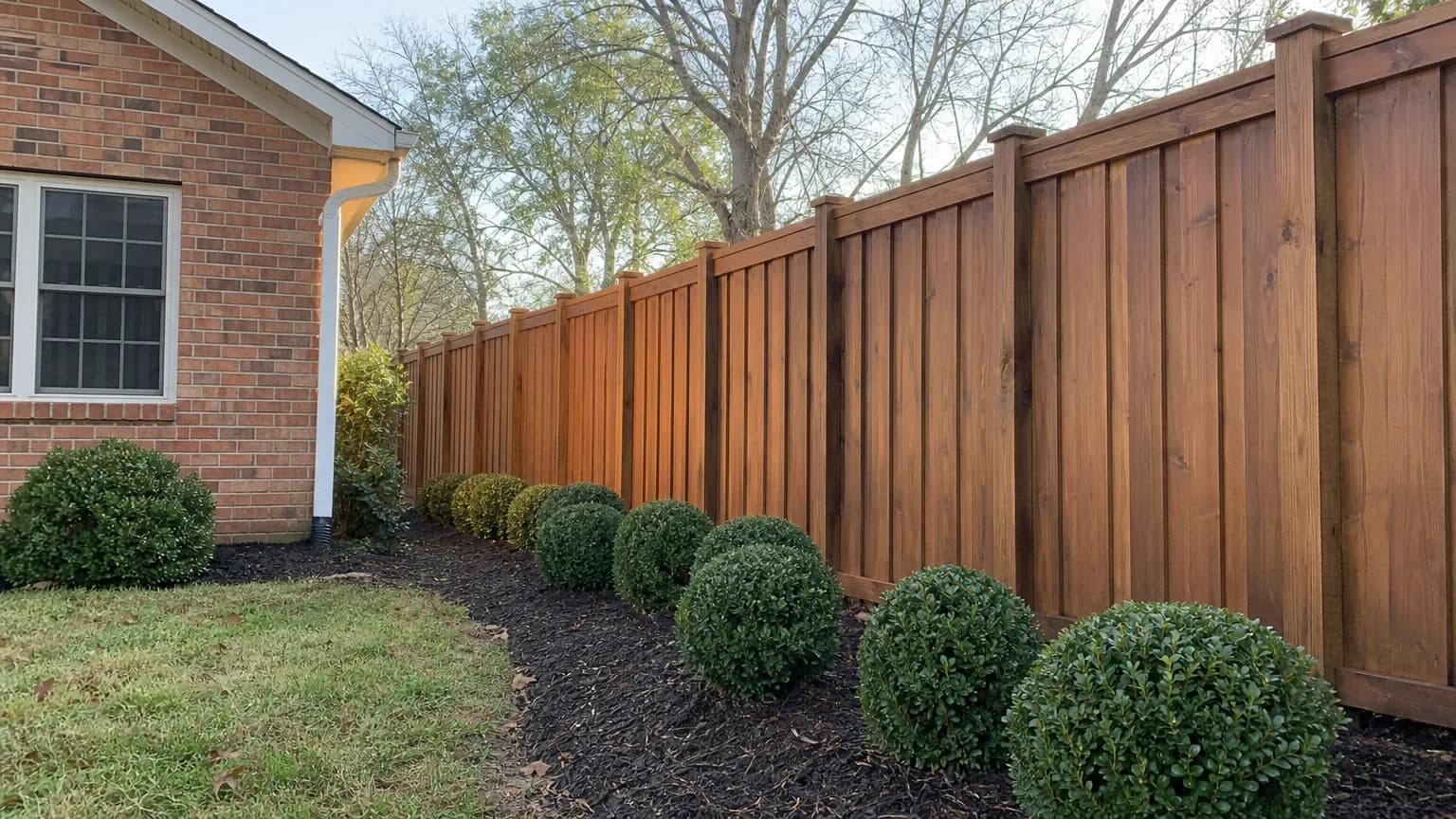
Privacy fence styles
Nearly every privacy fence in the area is one of four builds. They differ in how much they block, how they look from the neighbor's side, and how they handle wood movement.
Side-by-side pickets (dog-ear or flat top)
Pickets butted edge to edge on one side of two or three rails. The least lumber and the lowest price. As pine dries, small gaps open between pickets, so it is 'mostly' private. The rails and posts show on one side, and some ordinances want that side facing in. Decatur's ordinance, for one, requires the more finished side to face outward.
Shadowbox
Pickets alternate on both sides of the rails with an overlap, so the fence looks the same from either yard and lets air move through. It uses more lumber than side-by-side and reads as a 'good neighbor' fence. You see through it only at an angle.
Board-on-board
Two layers of pickets on the same side, the second layer covering the gaps in the first. Fully private even after the wood shrinks, and the heaviest of the wood options, which means it catches the most wind. Often finished with a cap rail and trim board.
Vinyl privacy panels
Tongue-and-groove vinyl boards slid between routed posts. No staining, no rot and no termites. Panels come in fixed widths, so slopes are stepped rather than following the grade. See vinyl fences for what separates a good panel from a flimsy one.
How tall a privacy fence can be
Six feet is the standard privacy height because it is the common limit for backyards. Front yards are lower across the board. Rules by jurisdiction:
- Huntsville: no fence permit, but zoning height limits still apply and differ between front and back yards. Confirm with Huntsville Planning (256-427-5100) before building over 6 feet or putting a solid fence forward of the house.
- Madison: no fence permit since 2017. City staff reports describe a 4-foot limit for solid fences in front and corner-side setbacks and 6 feet in rear and interior side yards.
- Decatur: fence permit required; residential districts allow 4 feet in front yards and 6 feet in side and rear yards, with posts up to 18 inches taller than the fence.
- Unincorporated Madison County: ordinary fences are exempt from a building permit; check height with the county inspection office.
Subdivision covenants are often stricter than the city. Many HOAs specify the style, the side that faces out and the stain color. Get the approval in writing before the contractor orders material.
Posts, clay and wind
A 6-foot solid fence fails at the posts, not the pickets. The Tennessee Valley is mostly red clay over limestone, often with chert, and Huntsville gets a little over 54 inches of rain a year. Wet clay against wood is where rot starts, and a solid fence takes the full force of spring storm wind.
- Depth: a common rule of thumb is one-third to one-half of the above-ground height, so 24 to 36 inches for a 6-foot fence, deeper at gates and corners.
- Treatment: posts should be rated for ground contact (AWPA UC4A or heavier). Above-ground-rated lumber in the ground rots fast.
- Drainage: concrete crowned above grade so water runs away from the post, or gravel at the bottom of the hole.
- Steel posts: galvanized steel posts behind wood pickets avoid post rot and termites entirely; ask what they add to the price.
Privacy fence cost
National guides put a wood privacy fence at about $25–$60 per linear foot installed, and vinyl at about $30–$60. Shadowbox and board-on-board sit toward the top of the wood range because they use more pickets. We found no Huntsville-specific pricing; local quotes set the number.
| Example run | At $25 per ft | At $60 per ft |
|---|---|---|
| 100 ft (one side of a lot) | $2,500 | $6,000 |
| 200 ft (typical backyard, three sides) | $5,000 | $12,000 |
| 300 ft (large lot) | $7,500 | $18,000 |
Add gates (about $879–$3,814 each nationally for installed gates, depending on size and type) and removal of an old fence (about $3–$8 per linear foot). See the fence cost guide for more on what changes a quote.
Before the contractor starts
- Find your property pins or survey. A fence a foot onto the neighbor's land is a fence you may have to move.
- Check HOA covenants and get written approval.
- Make sure someone has called Alabama 811 at least two full working days before digging, and the utility marks are down.
- Agree on which side faces out, where the gates go and how the fence handles slope (stepped or racked).
- Ask how long the posts' concrete sets before pickets go on.
Main guide: fence companies in Huntsville, AL.