How a horizontal fence is framed
On a vertical wood fence, pickets hang off two or three rails, and each picket only has to carry its own weight. On a horizontal fence, every slat is its own beam, stretched across the gap between posts. That one difference drives most of the design choices.
- Board size sets the span. Published design guidance puts a 1x6 board (3/4 inch thick) at spans up to about 6 feet, a 5/4x6 board at 6 to 8 feet, and a 2x6 as the stiffest option, at roughly 50 to 80 percent more material cost.
- Mid-span nailers. For spans over 6 feet, a vertical nailer board at mid-span keeps slats from sagging in the middle.
- Closer posts. Horizontal wood fences typically put posts about every 6 feet, versus 8 to 9 feet for a vertical fence, which works out to 30 to 50 percent more posts on the same run.
- Post stock. 4x6 or 6x6 wood posts, or steel posts with the slats screwed to a wood or metal frame.
Gaps: tight privacy or spaced slats
Slats are either butted tight for full privacy or spaced, commonly between 1/2 inch and 1-1/2 inches apart. Spaced slats let air move and read as more open from the street, but a 1-1/2 inch gap is easy to see through up close. Tight slats give privacy close to a solid privacy fence but still open slightly as the wood dries.
Spacing also changes how the fence handles wind. A solid horizontal wall catches the full force of a spring thunderstorm, and Dixie Alley storms bring straight-line wind and hail most years. Spaced slats let some of that pressure through, which takes load off the posts.
Materials: cedar, pine, hardwood and composite
Cedar
Cedar is the usual first choice for horizontal work. It is stable, holds its shape better than pine across a long span, and takes a stain evenly, which matters on a fence where every board is on display.
Treated pine
Pressure-treated pine is the budget option, and design guides describe it as prone to warping. A horizontal board that cups or twists is far more visible than a vertical picket doing the same thing. With more than 54 inches of rain a year and hot, humid summers, the wood here cycles between wet and dry often, so pine slats should be well fastened, kept to shorter spans and sealed.
Hardwood
Ipe and similar hardwoods are the premium end: dense, stiff and heavy. They cost the most per foot of any wood option.
Composite
Composite boards also come in horizontal styles. They do not rot, but composite boards are less stiff than wood, so they generally need shorter spans. See composite fences for the details.
Posts in Tennessee Valley clay
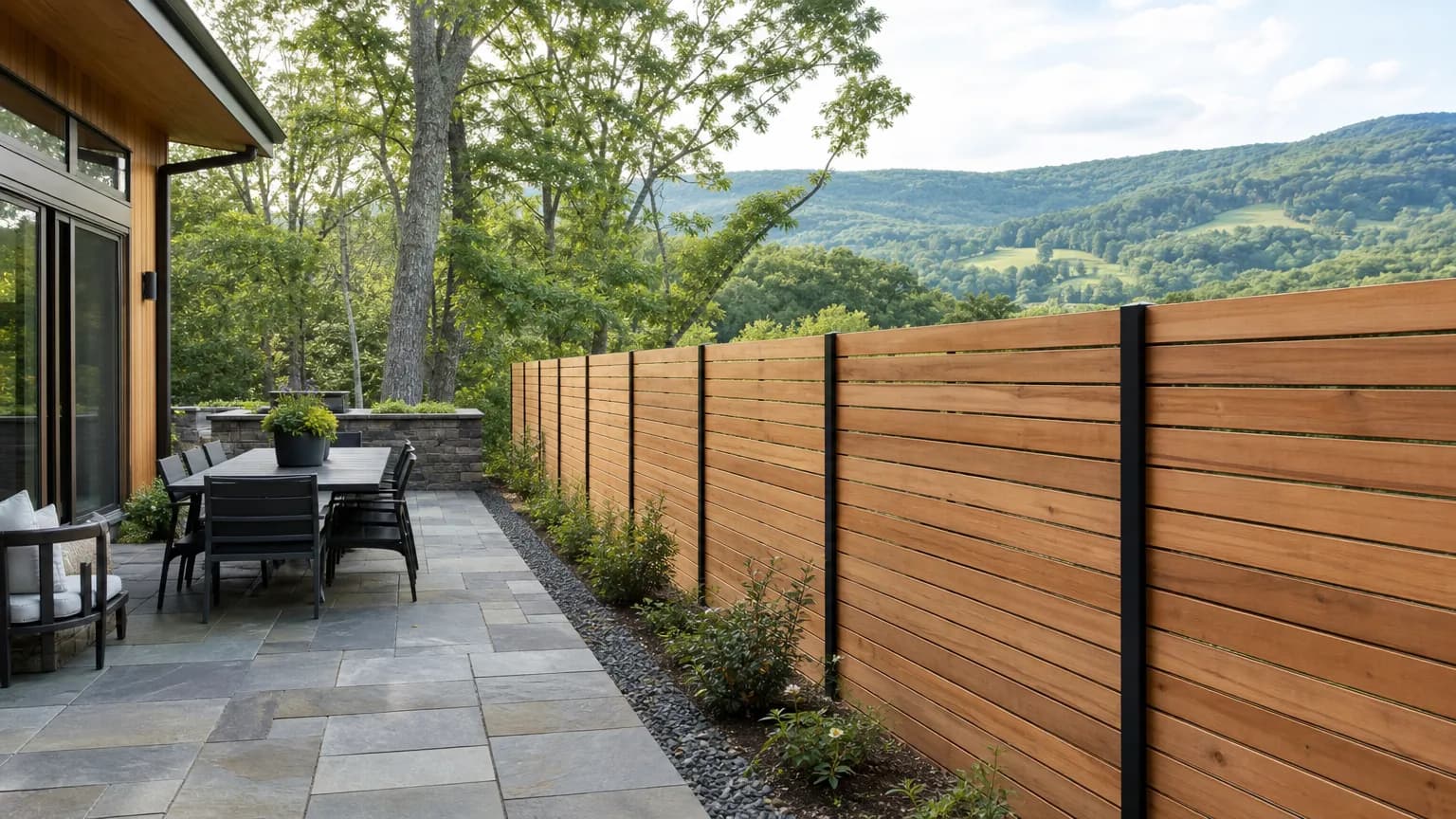
Horizontal slats hide the posts less than a vertical fence does, so many homeowners choose black steel posts, as in the photo above. Steel does not rot in the red clay that covers much of the Tennessee Valley, and it holds a straight line under heavy slats. Wood posts must be rated for ground contact (AWPA UC4A or heavier). A common rule of thumb sets posts one-third to one-half of the above-ground height deep, so 24 to 36 inches for a 6-foot fence, with concrete crowned above grade so water runs away.
Alabama 811 has to be notified at least two full working days before any digging, and a horizontal fence has more holes than most.
Horizontal fence cost
Two published sources give installed ranges, and they do not agree, so treat both as a sanity check rather than a price:
| Build | Published installed range |
|---|---|
| Treated pine slats | $25–$40 per linear ft |
| 1x6 cedar, spaced | $32–$50 per linear ft |
| 5/4x6 cedar, tight | $38–$55 per linear ft |
| Cedar on a steel frame | $45–$65 per linear ft |
| Ipe or hardwood | $60–$90 per linear ft |
| Horizontal wood, all types (second source) | $50–$91 per linear ft, 40–80% above vertical |
These are national figures, not local quotes. For comparison with other fence types, see the fence cost guide.
HOA and height rules
Horizontal fences are a style many subdivision covenants do not mention, which means architectural review boards often want to see a drawing first. Get the approval in writing, with the board size, gap and stain color, before material is ordered. Height limits are the same as for any fence: backyards are commonly capped at 6 feet and front yards lower. The fence permit guide lists the rules by city and county.
Main guide: fence companies in Huntsville, AL.