Two, three or four rails
Rail count sets the height and the look. Typical heights from suppliers:
| Style | Typical height | Common use |
|---|---|---|
| 2-rail | About 36 in | Front yards, driveway edges, marking a corner |
| 3-rail | About 48 in | Property lines, larger yards, with mesh for dogs |
| 4-rail | 54–60 in | Taller boundary, paddock look |
A 3-rail fence uses 50% more rails than a 2-rail fence, which cost guides put at roughly $2 to $4 more per linear foot.
Posts, spacing and clay
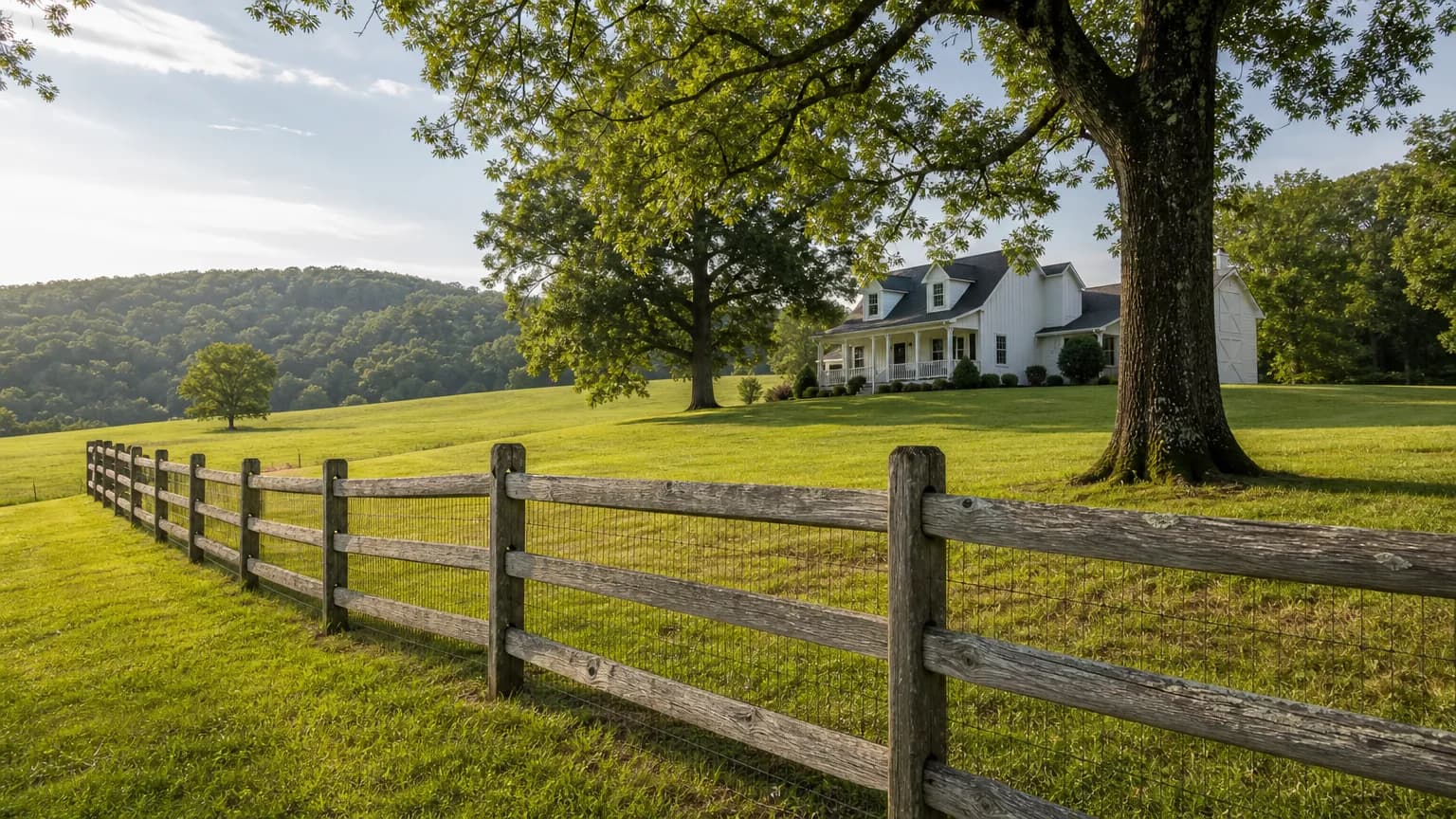
Split rail posts have holes (mortises) cut through them, and the tapered rail ends slide in from each side. Posts sit about 8 to 10 feet apart; standard 11-foot rails set posts at 10 feet 4 inches on center. Because there are no pickets, the posts carry the whole fence.
- Depth: a common rule of thumb is one-third to one-half of the above-ground height, so roughly 16 to 24 inches for a 48-inch fence, deeper in loose soil.
- Soil: Tennessee Valley red clay holds water after rain, and North Alabama gets a little over 54 inches a year. Gravel at the bottom of the hole, or concrete crowned above grade, keeps water moving away from the post.
- Rock: chert in the clay can stop an auger; ask how the contractor handles it.
- 811: Alabama law requires notice to Alabama 811 at least two full working days before digging, homeowners included.
Pine, cedar or black locust
Published installed cost by species, per linear foot:
| Material | Installed per linear ft |
|---|---|
| Pressure-treated pine | $15–$25 |
| Cedar | $18–$30 |
| Black locust | $20–$40 |
| Vinyl or composite rail | $15–$35 |
Treated pine posts should be rated for ground contact (AWPA UC4A or heavier), because Alabama sits in the very heavy termite-probability zone and soil contact is where rot starts. Black locust is described as one of the most rot-resistant hardwoods in North America. Cedar costs a little more than pine and is the usual pick for a natural, unpainted rail.
Wire mesh backing for dogs
Open rails will not hold a dog or keep a neighbor's dog out. Welded wire mesh fastened to the inside of the rails turns a split rail fence into a containment fence while keeping the open look. Cost guides put mesh backing at about $1.66 to $10 more per linear foot, depending on the wire. For a dedicated dog yard, see dog fences.
Front yards and livestock
Split rail is a natural front-yard fence because it stays under common front-yard limits. Decatur caps residential front-yard fences at 4 feet, and Madison staff reports describe a 4-foot limit for solid front fences with more open designs allowed somewhat taller. A 2- or 3-rail fence clears both. Decatur also requires fences to stay out of the public right-of-way and out of visibility triangles at corners, so set the line back from the road and the driveway. The fence permits page has the rules by city.
For horses, cattle or goats, rails alone are rarely enough. Horse fencing, no-climb wire and board fence are covered on the farm and horse fence page.
Split rail fence cost
Published national ranges, not quotes: split rail installs at roughly $15–$39 per linear foot, with most projects at $20–$25. HomeGuide puts 2-rail at $15–$20 and 3-rail at $20–$25 per foot. Mesh backing, black locust, gates and rocky ground push the number up. For other materials, see fence cost. Send your footage and rail count through the contact page to get written quotes from local contractors.
Main guide: fence companies in Huntsville, AL.